
Duck Factory Balancing Act
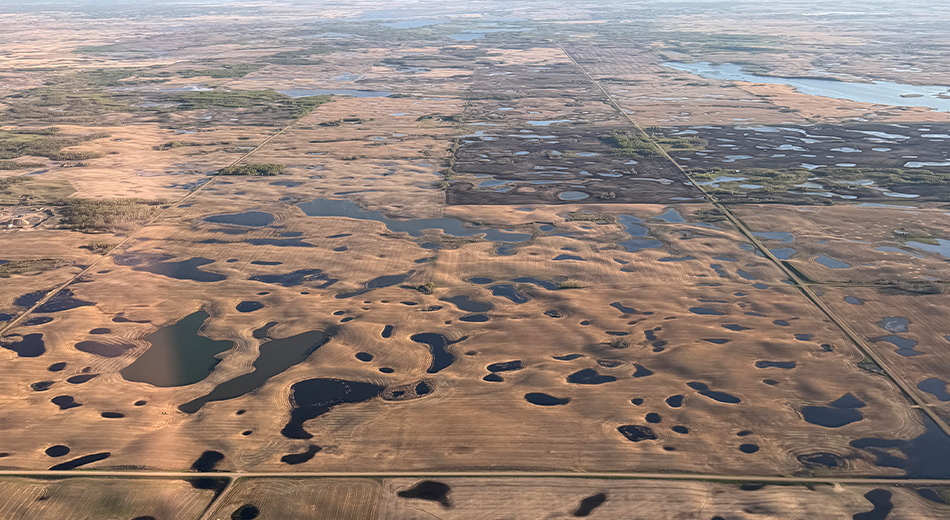
As waterfowl habitat declines, Delta’s innovative programs are maximizing the breeding grounds to produce more ducks for hunters
Dan Brown can tell where his traplines end by doing a quick survey of the wildlife on the landscape.
“I drive 2 miles outside my trapping area, and I hardly see a duckling,” he said. Since 2009, Brown has worked as a contract trapper for Delta Waterfowl’s Predator Management program, which focuses on trapping duck nest predators in targeted areas with the greatest potential to produce ducks. Within the 4,000 acres of grasslands in North Dakota where he’s been running traps every spring from mid-March to mid-July, the proof that his efforts are paying off comes with every duckling sighting.
“By the second, third week of June, you’ve got yellow puffballs swimming around everywhere,” Brown said. “That’s a key indicator for me that I did my job well.”
The numbers back up what Brown is witnessing on the ground in the prairie pothole region, where up to 70% of ducks harvested in North America originate. In trapped areas, nest success — defined as a nest with at least one hatched duckling — can be close to 50%, while in many parts of the breeding grounds that figure can drop below 10%. A hatch rate of 15% to 20% is required just to maintain local populations.
Brown views his trapping efforts on the prairies as a way to maintain a place for ducks in an ecosystem that has evolved over thousands of years.
“We don’t have those big apex predators that manage the numbers of duck nest predators like skunks and raccoons,” Brown said. “That’s part of it. But also, the landscape has changed, the habitat has changed, and farming practices have converted grasslands to crops.”
Today, duck nest predators have proliferated to unprecedented levels, and in many cases, they’ve expanded to regions where they were once absent or existed in smaller numbers.
After European settlement, homesteaders and habitat fragmentation pushed out large predators such as wolves and bears. Trappers then took the place of apex predators on the prairies, but their ranks have declined as fur prices have fallen.
“Delta’s Predator Management program is an effort to restore that predator and prey balance on the breeding grounds,” said Joel Brice, Delta’s chief conservation officer.
Along with trapping, Brice said Delta’s strategy to increase duck production and restore balance to the breeding grounds includes deploying Hen Houses. These cylindrical nesting structures are lined with flax straw and mounted on poles over semipermanent wetlands, placed strategically in areas of the breeding grounds that attract high densities of nesting mallards, but where grassland nesting cover is scarce. The Hen Houses keep ducks and their eggs safely out of reach of most mammalian predators. Nest success is up to 12 times higher in a Hen House than for a hen that nests in nearby ground cover.
Delta’s Duck Production efforts help to grow the size of the fall flight at a time when habitat loss and increased nest predation are putting pressure on duck numbers across the prairies. Together, Hen Houses and Predator Management will produce 1 million ducks each year in perpetuity, a result of Delta’s successful Million Duck Campaign that garnered $284 million in contributions and pledges within three years of its launch in 2022.
“Trapping and Hen Houses are not a replacement for habitat protection efforts,” Brice said. “Rather, they are an acknowledgment that we need to maximize production on the lands that remain while those long-term habitat battles are being fought. The effort to protect habitat is a generational effort, but Delta’s Duck Production tools raise ducks today.”
Nest Success in the PPR
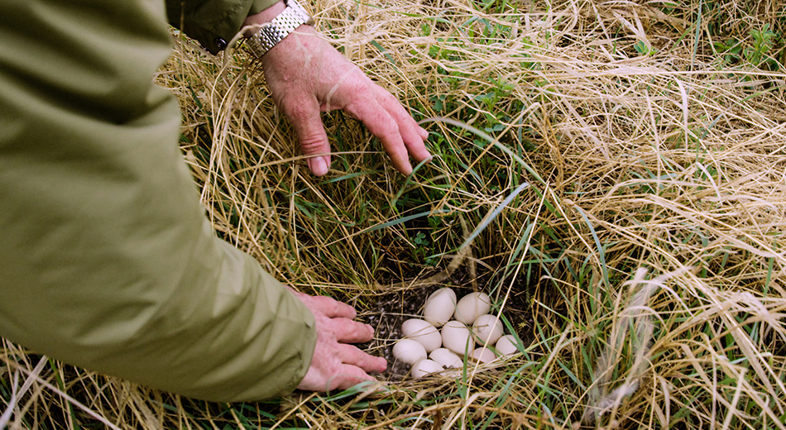
As more small wetlands are drained every year in the PPR and grassland gets converted to cropland, nesting ducks and predators are increasingly confined to the same patches of ground. The quality of the remaining habitat matters too. If nesting habitat contains sparse ground cover or limited water, nest success plummets.
“Predators love fragmented habitat and to work the edges,” Brice said. “So, in those fragmented environments, predators are much more efficient at finding and destroying duck nests.”
Fragmented habitat exists over much of the breeding grounds, but Delta’s trapping efforts are focused in targeted areas of North Dakota, South Dakota, Alberta, Saskatchewan, and Manitoba. Brown’s traplines cover areas with heavy concentrations of breeding ducks in northeast North Dakota, where Delta has identified low levels of nest success due to predation — all of Delta’s trapping efforts target places where ducks are abundant, but nest success is low.
The program’s goal isn’t to eradicate predators, but to manage them at levels that increase duck nest success. Achieving this balance takes consistency. Most of what determines whether a duck population grows or shrinks happens each year during the breeding season, a window of about 90 days. Whatever happens on the prairies and parklands each spring largely decides the size of the fall flight.
Differences in nesting habits and nest location can shield certain duck species from habitat fluctuations and predation, according to Jay VonBank, Delta’s scientific director. Canvasbacks and many other diving ducks nest over semi-permanent or permanent water, largely insulated from year-to-year drought swings.
“That’s part of the reason why diver populations are a bit more stable because they don’t have those huge habitat fluctuations,” VonBank said.
For dabbling ducks, environmental factors are highly influential.
“The prairie ducks — mallards, pintails, gadwalls, shovelers, bluewings — are all grassland nesters that depend on those temporary, seasonal wetlands,” VonBank said.
“That’s why you see bigger fluctuations in productivity year to year on average than the other species such as divers.”
Renesting habits split the dabblers further apart. Mallards, for example, are prolific renesters.
“Pintails and bluewings still renest, but not nearly as readily as mallards and gadwalls,” VonBank said.
Risky Business
That persistence can work in the mallard’s favor. But it also subjects them to additional predation. A hen mallard spends roughly 30 days exposed to ground predators between laying and hatching — the single riskiest stretch of her year. More nesting attempts mean more time on the ground, and more time on the ground increases the odds she will die trying to hatch a nest.
“Breeding season survival has declined for hen mallards, and it’s because of predators,” VonBank said. “So, it’s not only nest success, but hen survival itself is in question.”
Delta’s Hen Houses can lower that risk. The structures are used primarily by mallards. In areas where ground-nesting mallards typically experience nest success of less than 10%, Delta Hen Houses consistently boost nest success to 60% and sometimes as high as 80% or even more.
“With Hen Houses, we’re looking to increase hatching rates and productivity to population-expanding levels,” Brice said. Across Manitoba, Saskatchewan, Alberta, and North Dakota, Delta has installed more than 16,500 Hen Houses, adding a projected 38,000 or more fledged mallards to the 2026 fall flight. Delta is working to install a total of 109,647 Hen Houses that are estimated to produce 250,000 ducks every year.
Delta continues to produce more ducks by establishing balance on the prairies, something once carried out by large predators, then homesteaders, and then fur trappers. For hunters, these efforts that encourage a more natural hierarchy on the prairies lead to stronger fall flights and increased hunting opportunities.
“Predator management has been happening since the beginning of time,” Brice said. “It’s just changed forms, and it’s our turn to manage predator populations because there’s nothing else out there now to do that.”