
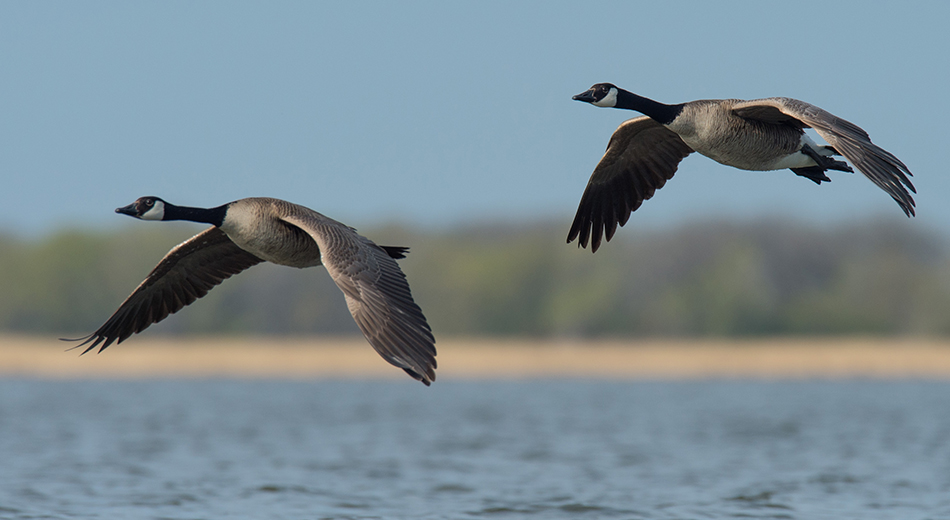
Hunters Can Expect Waves of Geese
Excellent production reported for AP Canadas and mid-continent snows
Atlantic Flyway goose hunters are eager to see what the season will bring. The 2026-2027 season is the first since 2019 to give hunters in New England and the Mid-Atlantic up to 45-day seasons and 3-bird limits. Maryland and Virginia, notably, chose 2-bird bag limits instead.
The region’s goose hunting heritage is long and legendary. While the season ahead may not match memories of “the good old days,” the numbers look brighter than the 2025 Population Status Report predicted. The U.S. Fish and Wildlife Service’s integrated population model had forecast 163,500 breeding pairs returning to northern Quebec, but the 2026 survey put the actual number at 170,000 pairs. Atlantic Population geese arrived on their nesting grounds in the Ungava Peninsula to find excellent water levels but faced a late spring thaw in the region’s northeastern portions. Once the weather warmed, though, U.S. Fish and Wildlife Service field reports noted excellent conditions for rearing goslings. The 2026 Waterfowl Population Status report puts A.P. Canada geese up 14% from last year and on par with the 10-year trend.
More good news for Atlantic Flyway goose hunters: Greater snow geese topped half a million, 20% higher than 2025. They remain 6% below the 10-year trend, however.
Dr. Jay VonBank, Delta Waterfowl scientific director, spent part of his summer on Victoria Island in the Canadian Arctic banding cackling geese and white-fronted geese.
“It was an early spring, mostly because the Central Canadian Arctic did not have a ton of snow over winter, so conditions were pretty good when birds arrived,” VonBank said. “Production for white-fronts and cacklers looked average to good. Last year and the year before, we had exceptional, bumper crops. So, we saw fewer broods this year, but age ratios looked pretty good a bit later in the season. That will make it an average-to-good year for production.”
VonBank said the outlook for mid-continent light geese is even better.
“Light geese had a bumper year. The Canadian Wildlife Service crews went in for light goose banding the week after we left and told us they had some of the highest age ratios they’ve ever had, which means great production on snows in the central Canadian Arctic.”
That’s great news for Central and Western flyway hunters.
Because the methodology for estimating mid-continent goose populations relies on banding data that takes time to be collected and analyzed, the most recent official estimates for these birds are from 2023 and 2024.
But VonBank’s observations on the productivity of mid-continent cackling geese, white-fronts, and snow geese are frosting on the cake for the 2026 survey report, which estimates Central Flyway specks up 5% year over year and cacklers up 3%. Snows, however, are still down 15% year over year and 8% below the 10-year trend. Even so, a great production year means plenty of juvenile snows during migration.
Resident Canada goose numbers remain strong in the Atlantic, Mississippi, and Central flyways. Even Washington, Oregon, and Idaho have September seasons, with seasons starting as early as Aug. 15 in North Dakota. The Atlantic Flyway resident estimate is 1.01 million breeding pairs, and the Mississippi Flyway giant Canada goose estimate is 1.38 million breeding pairs. Both are close to their 10-year trend lines. State by state, though, spring counts of Canada geese were down in North Dakota, Minnesota, and Wisconsin but up 7% in Michigan, putting the state about 25,000 birds above its long-term desired management goal.
Ross’s geese saw the biggest decline in the survey. Again, because of the population estimation methodology, the most recent official numbers are from 2023 and 2024. Estimates went from 3.6 million in 2023 to 1.4 million in 2024, a 61% drop and 5% below the 10-year trend.
VonBank is tuned in to production reports from banding crews across the Arctic. He’s heard from Alaska’s North Slope that Pacific brant production looked surprisingly good, and that snow geese were up again there as usual.
“Snows had another great year in Alaska,” VonBank said. “However, there was no operational banding of whitefronts or cacklers on the North Slope this year.”
He reported, though, that crews completed projects on molting Pacific white-fronted geese and banded their full quota, so production of specks for western hunters was likely at least average to good. The survey showed Pacific whitefronts at 506,000, up 7% year over year but still 5% below the 10-year trend line.
A bright spot for West Coast goose hunters: The survey’s estimate for cackling minima jumped 38% to 171,000 in 2026.
Overall, geese remain resilient to changing weather patterns and habitat conditions. Hunting them in any flyway offers extended seasons, a great way to introduce new hunters to waterfowl hunting, and memories that last a lifetime. — Bill Miller